
Volume 1, Number 2 2008
Maurice Oliver
A SHRINE TO LIFESAVERS
In this scenario my voice is left intact and
completely recyclable when I drown. The
day it happens four-letter words stroll along
the lakefront and storm clouds form a riddle
in the sky. The night before it happens the
town is in full fiesta as real flowers grow out
of the witch’s broom. The signs are already
ominous though. Instead of a head I have a
striped-on plastic ball in its place, and my Afro
wig tilts to one side. The next day is Sunday.
When I wake up the Lord has already risen
and made sunny-side-up eggs for breakfast.
I never eat breakfast and hate eggs fixed
that way. I hate baseball caps and baseball
too. Now that I think about it, I never much
cared for float-bed trucks or snot rags or
swimming lessons either. Guess that’s why
I’ll drown. And the striped-on plastic ball for
a head doesn’t help matters one bit. Nor does
being a great kisser or having the ability to
repair a refrigerator. So I sink deeper into the
lake once the boat tips over. And all the while+
there is a constant plumbing of my spirits in
my rusty pipe of wanting. Heart-shaped pebbles
or prevarication is a mariachi band. Perceptions
crystal clear to the end-stop. And as everything
goes black I desperately try to convince myself
that I could have left the raincoat in my hotel
room and wore my new red leather pants instead.
Maurice Oliver is the editor of the literary and arts ezine Concelebratory Shoehorn Review. His poetry has appeared in numerous national and international publications
and literary websites including Potomac Journal, Frigg Magazine, Stride Magazine, Blueprint Review, and Abrabesques Review. He lives in Portland, Oregon.
Jukka-Pekka Kervinen & John M. Bennett

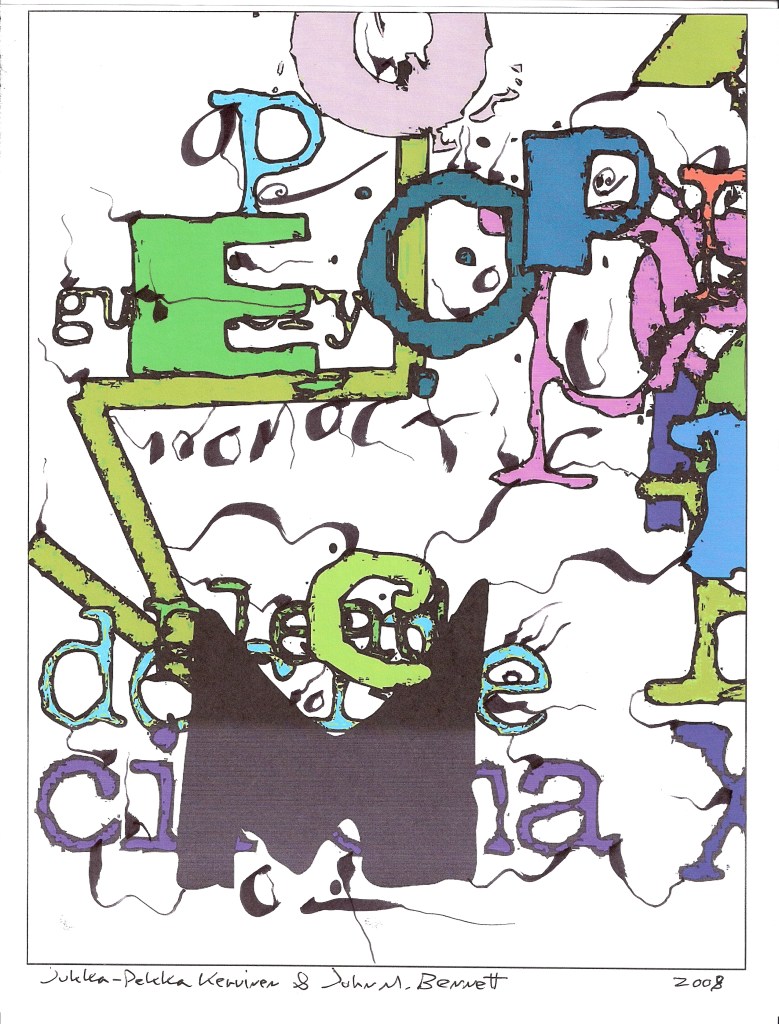
Jukka-Pekka Kervinen is from Finland. His work has appeared in numerous publications.
John M. Bennett is a poet and artist who has been published widely. He lives in Columbus, Ohio.
Frederick Pollack
THE KILLER OF BANDITS
Among the proprietors of our province
the greatest is Dom Pedro.
My Christian name also is Pedro,
and he addresses me as “my friend.”
His automobile acquires me
at the station, and as it
proceeds, I ask the chauffeur
(he is the son of a cousin)
about his family.
His answers are always the same,
whatever is really happening,
his gratitude undimmed.
The house (the palace rather) sits
near the shore, surrounded by lawn.
As I walk up the steps
(slowly, for I walk slowly)
Dom Pedro, although a man of noble size,
bounds out, and takes my arm
with great solicitation,
as if I had walked the many miles from our village.
He leads me to a chair
in his office, beneath a fan,
and a servant (the nephew of a late
colleague) brings fruit-juice;
as always, liquor is offered but I decline.
I make my report, about heads
of livestock stolen and recovered,
contraband seized,
the affair of the priest,
the circulation of forbidden
ballads. I hand over
the bailiff’s latest accounts (which presumably tally;
it is not he but I who make this journey).
My patron endures,
perhaps enjoys, my halting rustic speech,
asks thorough questions, then
inspects at length the contents of
my other envelope:
those photographs on heavy stock, of heads
on poles facing the forest.
I name those I can,
conjecture the names of others, and
(superfluously, but it has become
a custom between us) count them.
“This many I have assisted to their deaths.”
He drinks (it is not for me
to say excessively); remains alert
as I ask for more arms,
money, horses, and
recruits – young heads from his villages
that otherwise might rest on poles next year.
“You’re not getting any younger,
my friend,” he says; and I, as always, say
“I ride more swiftly than I walk,”
and he as always laughs and grants me all.
Then we stroll (” – the two Pedros!”)
among his paintings, books, and swords; beneath
his chandeliers that are like stars in daylight.
He demands that I dine
with him and the Senhora and his daughters
(whom I have never seen).
I demur, pleading my liver.
He offers me a bedroom
where generals no greater than I have slept;
I tell him I cannot bear a soft mattress.
I accept, however, a cigar
and, gazing at the sea, we sit and smoke.
He has retained the photographs,
and fans them out and closes them like cards.
A book lies on a table.
“Do you believe, my friend, that the soul
is solid? What I mean is, that it contains
its actions and beliefs, its
affections – and that all are stamped
with its name, like objects in a hotel room?
Or do they wander
alone, isolated, like people in the city,
and only form by chance into a man?
It is a difficult question, you needn’t answer.”
But I, perhaps stung,
more likely weary, say, “Perhaps,
Dom Pedro, it is one way in this world –
solid in this world, liquid in the next,
clotting at will into different
affections, as you say; or loyalties.”
PANCHO VILLA’S LAST WORDS
The profile of the undiscovered deposit
resembles the generous spikes of the maguey
and rises to within a hundred meters
of the driest mummy in Guanajuato.
No one, however, can read her inverse smile,
commanding eyeless stare, or rigid gesture.
None tries, although one stands in line for her
for hours, looks, then gets back on the highway,
where, between GM’s yellow mile-long wall
and the wrinkled mesa with its boils of mountains,
a semi, like a great goat, plays with him.
That shipment will wait for no man, and no policeman.
Am I eagle or sun? asked the poet. Am I sparrow or streetlight,
intermittent, green in the all-pervading dusk
that leaches paint and slogans from mud walls?
On rusted tracks beside the road, an idling
locomotive draws ahead, and stolid
faces crammed into each carriage break,
above crossed bandoliers, into obscenities.
In the distance where they stop, the festive noise
of gunfire must make it hard to hear.
“Don’t let it end like this. Tell them I said something.”
Frederick Pollack is the author of two book-length narrative poems, The Adventure and Happiness, both published by Story Line Press. His writing has appeared in such
publications as Hudson Review, Southern Review, Poetry Salzburg Review and The New Hampshire Review. He is an adjunct professor of creative writing at George Washington University, Washington, DC.
David-Baptiste Chirot
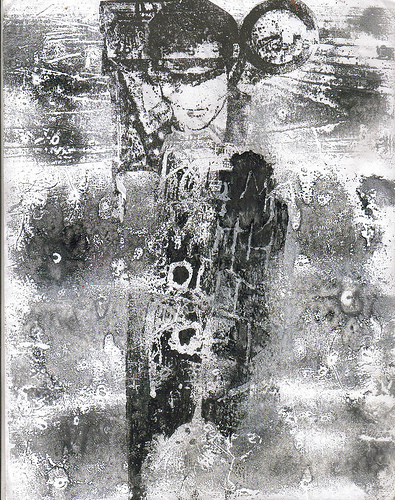
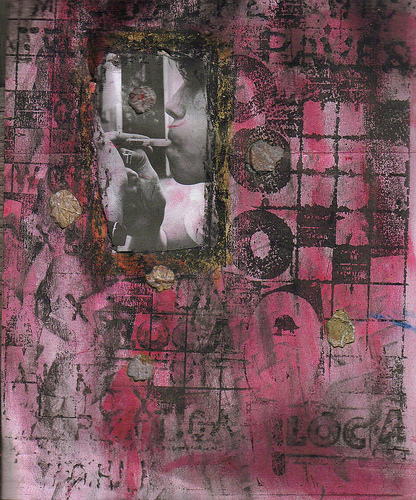
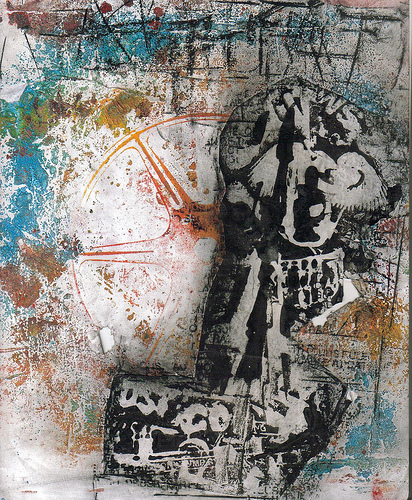
David-Baptiste Chirot lives in Milwaukee, Wisconsin. His work has been published extensively.
Alex Stolis
NINE LIVES ARE NOT ENOUGH
I
Two cars and a dog, a CD collection
that includes Sinatra and Basie–
enough cocaine to forget you have them.
II
A photo of the Eiffel Tower, worn
away at the edges; golf shoes
one size too small and a bird’s nest.
III
Cold steel against your face, rent
three months behind, but enough
is enough and you move back home.
IV
A porcelain faced girl who loves
to grow daffodils but can’t live
with your overnight trips to L.A.
V
A 1977 Ford Thunderbird with one
month’s payment left, bald whitewall
tires and a trunk full of cassette decks
VI
A maid named Francine who reads
the headlines from the NY Times
while you cop a look at her breasts.
VII
One used needle, a half melted candle;
a friend, who loves you like the brother
he shot when he was twelve–a runny nose.
VIII
A book of matches from the Hilton
two thousand dollars in cash, three
platinum credit cards and one cigar.
IX
A worn copy of On the Road, a map
of Boston in your glove compartment
a crooked smile that women fall for.
Alex Stolis lives and works in Minneapolis, Minnesota. His writing has appeared in numerous publications.
Michael Keshigian
ON THE LAKESIDE HAMMOCK
He daydreams,
his head off the side,
as if to heave,
contemplating aspects of himself
in relationships,
minute reproductions
cloaked in appropriate disguises,
sitting around a campfire
discussing the quizzical question
as to which of them
is his truest appearance.
Like the quick flip of pages
through a girlie magazine
when looking for the pictures,
they argue their points
as they consider the images:
here he is holding hands
on a walk through the city park,
buying flowers,
an ostentatious display,
another with him smoking a cigar
at the titty bar bachelor party,
grabbing, as he pokes dollar bills
into crotchless panties,
in Boston at the symphony,
discussing aspects of Stravinsky
with his date,
flirting with his girl’s best friend,
asking the dominatrix
if he will ever feel
the noose tightening on his…
“What the hell!” he screams aloud,
abruptly snapped from the fantasy
when two flirtatious women
dump pails of lake
upon his sun burned body
to inquire as to what
he might feel like doing.
Michael Keshigian has appeared in numerous publications such as Boston Literary Review, Poetry Depth Quarterly, The Aurorean and Pegasus Review. He lives
in Londonderry, New Hampshire.
Bob Bradshaw
This is your first time modeling nude
and you want to drop your robe
as if you were a geisha
slipping out of her kimono.
But the air is as cold
as a stethoscope.
Students break their paints out, scrape
colors across boards
as if mortaring a damaged house.
You feel reassured.
Still one gentleman stares
at your breasts as if wanting
to leave his hand prints on them.
That’s when you focus on the building
across the street.
The window with the man
holding the binoculars?
You squirm. “Don’t move,”
the instructor says.
You hope this is a class
of abstract expressionists.
It isn’t. Don’t worry,
the instructor says. Here,
it’s art for art’s sake.
And then quietly he asks,
Are you doing anything
after class?
Bob Bradshaw is a programmer living in Redwood City, California. His writing has appeared in such publications as Electica, Mississippi Review, Pedestal Magazine
and Lucid Rhythms.
Ellen Jantzen
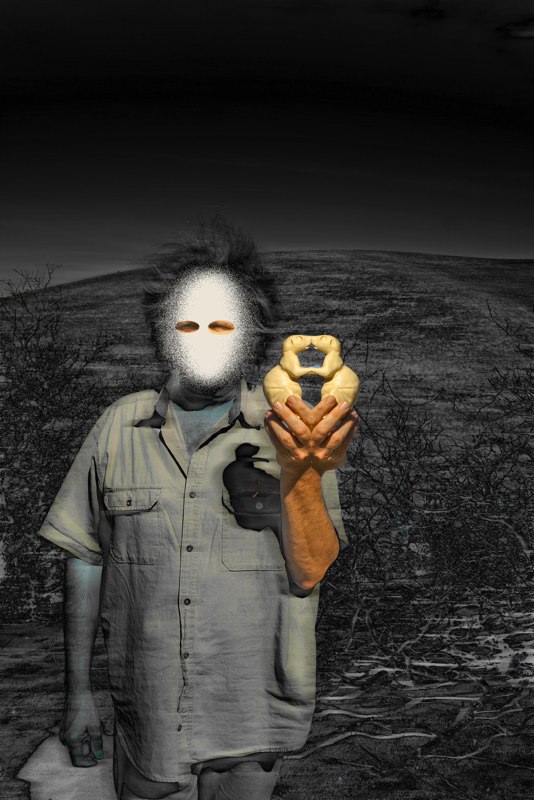
Ellen Jantzen was born and raised in St. Louis, Missouri. She currently lives in Valencia, California. Her work has been exhibited widely.
M. Bartley Seigel
A GIRL LIKE CRACKED PORCELAIN
A girl like cracked porcelain, a cutter and bleeder, bored as cattle, sits in the weeds
at the edge of a field under a sun like a cold trencher, smoke and ash, her third eye
watching black satellites orbit like crows. She is a collapsing star, all gamma, radio
pulse, not birdsong, her voice burlesque, a wild-eyed whisper like shards of glass,
barbed wire in the meat of a tree, terror embroidered lock jawed and dissembling.
A girl like this is nightfall, thunderhead, mushroom cloud, a shock wave rippling
over a darkening plain, her gravity a dance, beautiful as a bullet. She brings down
disaster no less now than ever, always and never simultaneous, like a river beyond
its banks, undeniable and insidious.
M. Bartley Seigel is Assistant Professor of Diverse Literatures and Creative Writing at Michigan Technological University and editor of PANK magazine. His work has
appeared in Diagram, Wheelhouse, Alligator Juniper, and elsewhere.
Dennis Mahagin
LAYERS & LAYERS OF MEANING
They’d been fighting
for the better part of an evening–she kept muting
the T.V. during every commercial as he tried to work,
confounding him with the intermittent silence and no
awareness of what she was doing.
“The suffocation babe,” he cried, “so hard
to put into words!”
“Yeah?… Well, tell me how best to keep abreast
of your imagination, Mister? You, who obsess
night and day on lines which have already been
said a damn sight better, anyway!”
* * *
Then, at around midnight, leaning
against the rain-streaked French windows of their balcony
on 45th and Hawthorne, he stared street-side–where the ghost
of Raymond Carver stood huddled in the moonlit halo-mist of the 7
Eleven sign, wearing a knee-length pea coat lined with little spiral
notebooks, like tinsel rows of hot wristwatches.
The master flashed
his famous elfin grin, made a sweeping
impresario bow that sent the wind in a whistle under
scalloped eaves–showing him how in that instant
the stripped and shivering branches
of the December plum tree could be made to dance
inside his plate glass, for as long as he blew hot ponds
of condensation there; and when the apparition spoke
it was in a guttural alien dialect that might
have been a cross between Swahili and Dutch
baptismal liturgies bounced off a marble font,
or something else entirely.
Sometimes you don’t have to know what someone
is saying–to understand everything, and Raymond
seemed to nod gravely
at this revelation,
as he made his exit ricochet
off the Hamm’s Bear billboard, and shot
straight for downtown on streetlight beams
as slalom ski poles that said:
“shhhh… shhhh… shhhh…”
* * *
“Do you want
anything from the store?” the writer
asked, cinching down the Druid hood
on his Seahawks sweatshirt. As he
stepped through the back door
there was this look on her face
that said she knew they wouldn’t
be seeing each other any more,
and he didn’t know
what else to tell her.
HE HORSE I RODE IN ON
–no fine platinum charger with a name like Midnight,
Galeron, or Whiplash the Appaloosa, a map of the world
on her ass and flanks, this horse I rode, bareback–barely
hanging to her stringy, dun mane as always, as reins, my
horse on heavy hooves, pebble smooth, the infectious clip-
clop din she ushers in, slapping off the rutted cobblestones
of all your sad parking lots–a lot like Mick Fleetwood’s
snare drum in the rock song called Over My Head, yet
hardly a Stevie, or McVie in throes of virtuosity are we, no
world shakers, can’t you see we’re just hobbling along here?–when I feel
her worst fears in a reared-back whinny, those hooves pawing at thin air,
as though to shake off a flinch–a pugilist’s pulled punch in the midst
of messy clinch– I lean hard into my horse’s corded neck, whispering
gratitude for the way she rescued me, on the cusp of Mojave barbecue–
pea pods, tattoo tracks and peyote pistils metastasizing from my pores
like the snap-crackle time-lapse vine-bindings of every damned
Gulliver, while the bandy-legged, prurient lot of you
formed a bob-and-weave binocular queue on ridge line, clocking
a miracle rarely seen this far north of Glue Factory, before… My
horse, sometimes called Corso’s Mistress of the Laughing
Sickness, Blunt Force Trauma, 20/20 Sangfroid, or
something else entirely on the spur
of a certain moment when,
becalmed at last, she’ll swish a silken
fantail, opalescent whisper in the dying sun,
then a sudden snort of something like delight
pours from my horse–says it’s kosher to sally
forth, to stay the course for as long as my
line of talk (what some might call Luck)
holds out.
So who is the Honcho
I need to see, about a sack of salty oats, cherry red hot
water bottle, and the finest wire brush ever fashioned
in these bucolic parts? There’s a score of ridge lines left
to climb, before our trailhead is diddled
for the last time by Perma Frost, Dust
Devil Dark, or whatever appellation
rings most true in this ghostly
little town you call home.
Dennis Mahagin’s poems and stories have appeared in Exquisite Corpse, 3 A.M., 42 Opus, Stirring, Juked, Thieves Jargon, FRiGG, Unlikely Stories, and Underground Voices, among other publications. He lives and works in Washington State.
Peter Chamberlain
Secrets of the Trinity Exposed
Moot, Zoot, Toot


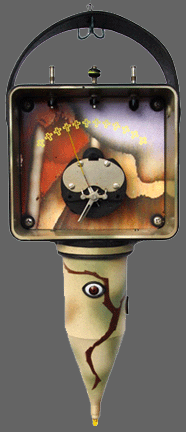
Peter Chamberlain is a professor in the Expanded Arts Program at the University of Hawai’i at Manoa.
Jason Huskey
You push the buttons on the phone
like some confused baby.
Stale vodka and no-name nacho chips
on your breath.
Halfway to vomiting for the night.
Your memory’s faded
the sequenced digits
like the peach dress
you wore to the junior prom.
Mixed sixes and nines nix the buzz
from your sweaty temples throbbing.
Throbbing,
something below the numbness
whispers tingling tidings
and nude thoughts
of libidinous intentions.
You reach a dial-a-psalm,
an automated response offering
daily prayer, by mistake.
The old woman’s voice reminds you
of your high school band
teacher, Mrs. Roberts,
though she’s been dead
for years now.
Seeing her in your mind now,
stiff between the satin-sheet siding,
you pull your legs up onto the couch
and let her voice sober your heart.
Deep inside,
you’re just ignoring the pain,
that nagging pinprick of truth;
he wouldn’t have talked to you anyway.
AFTER A FIGHT
Our blood mixes
about the valleys of my knuckles,
joints jammed and locked,
skin split and burning;
and I’m here by the tub,
running through rubbing alcohol,
trying to get your poison out of me.
One day I won’t be around
to finish what you start–
even though you haven’t landed
a punch in years.
Years of this
wasted in busted hands
and weekends–
like I have the time,
your dad never spent,
to get you to listen,
to hear it straight as a cross;
but I guess you prefer it
one jabbing syllable at a time.
Flesh to bone to flesh to bone,
until you’re halfway to hell
on the sidewalk of your choosing.
At least you got the girl,
always the girl,
like a slave just along for life.
Isn’t it always like a woman
to crave a blanket of fleas
until years after the bastards start to bite?
And isn’t it always like us
to keep on living
years beyond our due?
Jason Huskey’s work has appeared in numerous journals, including Keyhole Magazine, Thieves Jargon, Word Riot, and Zygote in my Coffee. He lives in Virginia.
Justin Hyde
STANDING IN LINE TO BUY LIGHTER FLUID AND A BIC
the cavanaugh house
is an old
army barracks
behind the
airport
where people
with no insurance
go to
die.
mr. arnold’s
been in
two months
with cancer
of the stomach.
i got the call
today
went down
over lunch break
for a doctor’s signature
so i could
close out
his parole file.
he’d strong-armed a bank
in seventy-seven
a week after
dropping out
of the
tenth grade.
did thirty years
got out this june
lived at the y
and ran stock
at the goodwill warehouse
for a month
before he started
coughing up
chunks of
intestine.
i’d check on him
every other week
he’d always remind me
to burn that cardboard box
with all of his possessions
at the foot of his bed
after the reaper
passed
through.
it’s not much
a fool’s bounty
but my brother down in keokuk
won’t claim me
and i don’t want the sharks
picking through
my bones,
he’d say
forcing a smile.
Justin Hyde lives in Des Moines, Iowa. His poetry has appeared in numerous publications.
Scott MacLeod
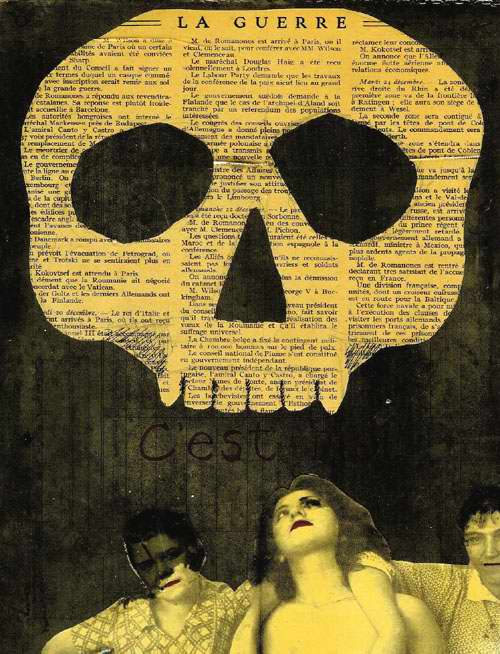
Scott MacLeod is a writer and artist who has published and exhibited his work widely. He lives in Oakland, California.
Gabriel A. Levicky
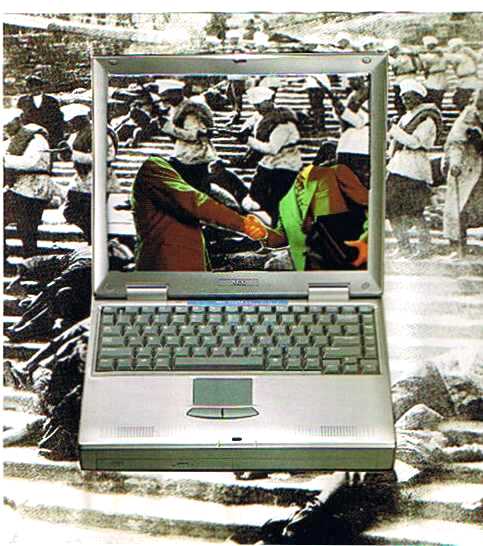
Gabriel A. Levicky is a writer and artist who was born in the former Czechoslovakia. In 1979 he escaped the persecution by the State Security and came to the United States. He presently lives in New York, New York.
D.B. Cox
STREET SOLDIERS
last night i saw you walk
out of the moon-driven dark
a gray beret, crazy bluebird tattoo
across your neck — Tu Do street, 1968
changed, but somehow still the same
you looked happy to be alive again
as if an angel had rolled back
the stone & pulled you out clean —
seeing your face triggered
something i couldn’t locate
like an address book with a missing page
names once vital, lost forever —
but i’m still here covering your tracks
addicted to weakness
relaxed by the fact
of never having to be strong again
so i wasn’t ashamed
when you walked by
pretending not to know me
i just re-aimed my dead eyes
to a place over your left shoulder
apologized & asked if you could buy
an old soldier of the street a bottle —
to help cheat the cold.
D.B. Cox is a blues musician and poet, originally from South Carolina, who resides in Watertown, Massachusetts.
Steve Klepetar
LETHE
On this side we meet, old friends
perhaps waiting in dust for the same train.
Waters trickle through layers of earth.
Here, on this side, we awake–
without cases or keys,
with no passports or tickets, with pockets
empty, with threads
drooping from cuffs and seams
groggy, heavy in the eyes
thirsty as if we had bodies alive
with sweat. We know our deaths too well
to embrace and mingle vapor shades.
No wind to carry voices, no song.
We murmur, we slowly move our hands.
We open our fists with slow fingers creaking.
We make small gestures–
with our hands we bless and curse,
with hands protect our shadow-darkened faces.
We sit in small circles, heads bowed
low toward our knees. Our hair trails
and sweeps. We have drunk the waters
of Lethe. Our memories unravel
like dreams. We burn, each one
of us, small fires flickering at the core.
Steve Klepetar teaches literature and writing at Saint Cloud State University in Minnesota. His work has appeared in such publications as Poems Niederngasse, Snakeskin, New Works Review and Mad Hatters’ Review.
13 MILES FROM CLEVELAND
Edited by Joe Balaz
Joe Balaz lives in northeast Ohio in the Greater Cleveland area. He edited Ramrod–A Literary and Art Journal of Hawai’i and was also the editor of Ho’omanoa: An Anthology of Contemporary Hawaiian Literature.
All works appearing in 13 Miles from Cleveland are the sole property of their respective authors and artists and may not be reproduced in any way or form without their permission. © 2008
 13 Miles from Cleveland