
Volume 4, Number 1 2022
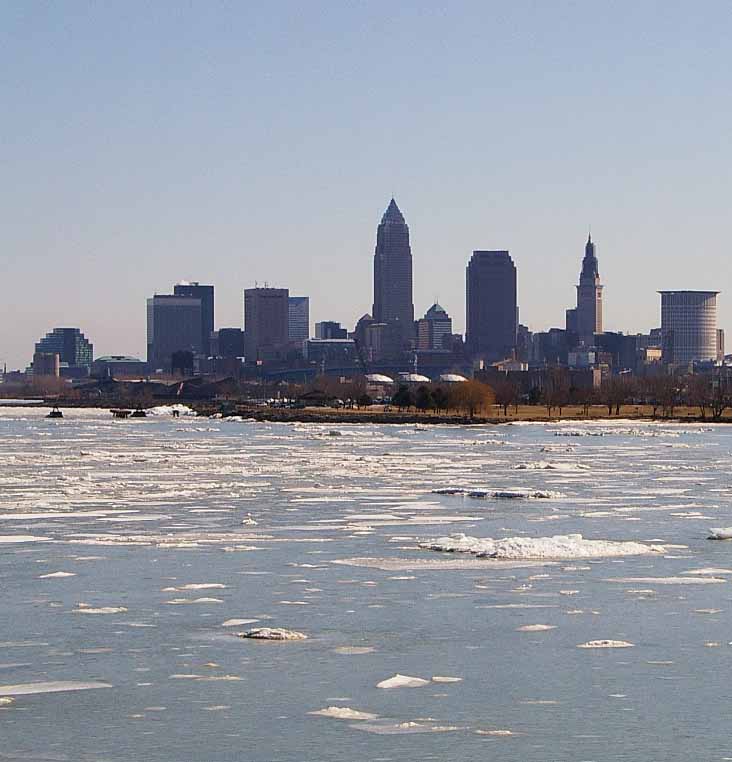
Kathy Smith
Rob Sean Wilson
ANANDA AIR, III
Three uncommonly handsome travelers are flying
In a balloon over Ames, Iowa, a woman
And two men. They can see the snow falling
To the fields below where children look up in
Bundles, with open hands, waving at the machine.
They are making aerial history.
They are making the weather talk to farmers
Who look up at the steaming smoke and applaud.
The arrogant man on the left is named Vincent,
He is the angel behind the project.
The festive, red coated man on the right
Is named George, the maker of the gilded balloon.
Between the two men sits a woman dressed
In white and black gowns, with a cowboy hat on:
Her name is Ananda, Ananda Air.
She looks down on the fields with open arms.
She is waving some flag, maybe the flag
Of a region in India called Panduranga,
Where the poet saints come from
When they are not reborn as trees.
It looks like the flag of England, where she was born.
But she is flying over a new land, has new feelings
Of upward bound tranquility and release.
She looks plaintive, as if the snow means disaster
And change. For her nothing is constant
Except the wind she follows, which blows the balloon
Across the plains of Iowa where cows exalt the grass.
Some rumors call the lady voluptuous, some sagacious,
But she goes on flying above this storm of need.
She takes a nickname for the journey, Sweet Tranquility,
Surprising the men like the early fall of snow.
She is off across the continent: Ananda, Ananda Air.
Kathy Smith
Visceral as a fresh caught cut perch
yearning as the dog looking hours out the window for the car’s return
I love you, I would say to my family
the gulp in my heart tendered between mortar and pestle
like the unexpected swipe of a burnt cigarette on the arm.
With some,
we spend more time together in dream
than real life
expansive surprises of rooms
come out of a flap of shuffling cards
like a rabbit out of a hat
We make a cardboard castle
We sit on the patio and watch the backyard pond
the trees as sweet to sight as
fresh washed salad
I know
the knowledge of what the Cuyahoga
has done to its banks over centuries
The accordion wheeze
the new born spring swallowtail
taking its first steps before us
we only know where it folds up its
wings to rest because we see
where it’s been
where we are now, where we
have been
Let’s hold it, let’s keep it here
Kathy Smith (Lady K) is a writer, poet, web designer and engineer from Cleveland, Ohio. She enjoys nature, listening to books, household and garden projects, and cooking. She is the editor of The City Poetry, a literary and art magazine of Cleveland, http://www.thecitypoetry.com, and more of her work can be found at Walking On Thin Ice, http://www.walkingthinice. She lives in Cleveland, Ohio.
Rob Sean Wilson is a Western Connecticut native who received a doctorate in English
at the University of California at Berkeley, and was the founding editor of the Berkeley Review. He has taught in the English Department at the University of Hawai’i at Mānoa and Korea University in Seoul, and was a National Science Council visiting professor at National Tsing Hua University in Taiwan. Since 2001, he has worked as professor of American literature, creative writing, and poetics at the University of California at Santa Cruz. He has written multiple books of poetry and cultural criticism, and his poems have appeared in numerous publications. “Ananda Air III” is from When the Nikita Moon Rose, his latest book of poetry.
Steven B. Smith
Joseph Stanton
TO THE HACKERS OF THE HEAVENS
Wielding your keystroke hatchets
you have done the deed and discovered
a drift of white mist and beyond it,
as far as your screen can scan,
a blue sky and a midday sun
too hot to click on.
As your evil algorithms
beat time on celestial storage drums,
your digital screens scrum
angels singing high-keys,
and your hackings find at bottom
cherubim dancing ecstatic
on the heads of memory pins,
chips off old data blocks,
and your hackings reveal at top
seraphim singing to an Absolute Being,
aloof and paring his finger protocols,
whose mystic eyes admit
no thefts of identity,
knowing exactly, as he does,
who you are.
MODERN TIMES
Charlie Chaplin’s best movie
makes a factory,
despite its inhumanity,
a place of precarious liberty,
a stage for prancing oil-can dancing.
All transpires within
a city’s cruel incivility—
this tale of unlikely love
between a tramp and a gamin,
who are, Chaplin declared,
“the only live spirits
in a world of automatons.”
Joseph Stanton is the author of seven books of poetry, the latest which is Prevailing Winds. His poems have appeared in Poetry, Harvard Review, New Letters, Antioch Review, Poetry East, New York Quarterly, and many other journals. He is Professor Emeritus of Art History and American Studies at the University of Hawaiʻi at Mānoa.
Steven B. Smith
We know
thanks to postcards from the end
it’s not destination
it’s the journey
the getting
not the gone
which makes me think
Sisyphus must be one happy dude
blessed by endless doing
never done
always on way up
before failing down
never reaching boardroom
to piss its gold-plated toilet
no kissing ass or playing blind
just rolling rock in endless climb
with time to enjoy view
as failure falls
in sparkle of downward dew
no worry
no warts
except (as always)
hurt for the heart
Smith was born, is living, will die . . .
Poems & art since 1965
he resides in Cleveland, Ohio.
Jim Kraus
IN THE PINEAPPLE FIELD, THINKING ABOUT VIETNAM
In the deep red soil surrounding
Wahiawā, Kunia, Poamoho
and Kūkaniloko, the birthing heiau,
teenagers do summer field labor.
We learned the disciplines of planting,
trimming (“cutting slip”),
weeding (“hoe hana”),
harvesting (“make quota”),
and of relaxation, posture, breath:
bend, pick a pine, repeat.
Behind, conveyor belt boom
that reaches over endless
rows of pine.
First a push, then a pull, then
the splattering of a rotten pine,
infested with black pineapple bugs,
across Mikey’s chest and face.
In a rage, he grabs more overripe pines
and begins throwing them at everyone.
One hits Ignacio, the tractor driver.
Tolentino, the luna, stands behind the tractor.
Then Funai leaps over a row of pine
and pushes Mikey hard onto the red dirt road.
Funai clenches his fists,
moves them in slow rotation,
and locks his arms in place,
one fist pointed to the ground,
halfway to where Mikey stands,
the other fist near his waist.
We had seen the movies
and knew how lethal fists could be.
Silence, brief stillness.
Tolentino forces a loud, long laugh.
And the whole gang lines back up behind the boom.
After that day, we didn’t see Mikey or Funai again.
Someone said the bosses made Funai a luna,
that Mikey worked night shift,
that they both got drafted and sent to Vietnam.
Summer, 1967
FROGSPAWN
Naval recruit training, San Diego, 1967.
Old Frog as young drill instructor,
known then as Froggy, having no visible neck.
Entire company inside concrete bunker.
Lesson: surviving fire at sea.
Froggy steps outside and shuts the metal door.
Fire! Fire! I remember the door.
Cover mouth with shirt.
Eyes useless, shut. Black, black.
Door, others already there.
Hot. Hot. Then suddenly opens.
We swim into the cold, fresh air.
Froggy yells, fall in, fall in.
We march toward nearby beach,
across rocks and sand.
Sound of waves approaching.
Carefully polished boots fill with
sand, cold water.
Waves now pushing us over.
Taking off boots.
Trying to stay afloat.
Now thrashing,
trying to swim,
to breathe, to breathe.
Jim Kraus lives in Honolulu. His poetry has appeared in Hawai’i Review, Kinalamten Gi Pasifiku Anthology (Guam), Poetry Hawai’i, Bamboo Ridge, Kentucky Poetry Review, Virginia Quarterly Review, San Marcos Review, Cape Rock Poetry Review, Neologism, Voices de la Luna, Another Voice and elsewhere. He earned a PhD in American Studies with specialization in environmental poetry from the University of Hawai’i at Mānoa. Currently, he is Professor of English at Chaminade University, where he teaches creative writing, environmental literature and surf studies. He also edits Chaminade Literary Review. He enjoys swimming, surfing, visiting art galleries and museums, and reading contemporary poetry.
Imaikalani Kalahele
Brandy Nālani McDougall
MEMORY
The kūpuna are all around us now,
caressing the grasses, the leaves
on each branch—they wonʻt let go,
just yet. Their dance makes the wind
brush the clouds across the sky—
strokes of an orangish hue
reflected in the gold of your eyes.
It is summer, a quiet breath
before the rain, and I am reminded
of how often they would say
the rain belonged to Wākea
as he reached for Papa through
the waves of air and miles of night.
But that was in the time before words—
the land, only a recent memory to the sky.
WATER REMEMBERS
Waikīkī was once a fertile marshland
ahupuaʻa, mountain water gushing
from the valleys of Makiki, Mānoa,
Pālolo, Waiʻalae, and Wailupe
to meet ocean water. Seeing such
wealth, Kānaka planted hundreds
of fields of kalo, ʻuala, ʻulu in the uka,
built fishponds in the muliwai.
Waikīkī fed Oʻahu people for generations
so easily that its ocean raised surfers,
hailed the highest of aliʻi to its shores.
Waikīkī is now a miasma of concrete
and asphalt, its waters drained
into a canal dividing tourist from resident.
The mountain’s springs and waterfalls,
trickle where they are allowed to flow,
and left stagnant elsewhere, pullulate
with staphylococcus. In the uplands,
the fields and have long been dismantled,
their rock terraces and heiau looted
to build the walls of multi-million dollar
houses with panoramic Diamond Head
and/or ocean views. Closer to the ocean,
hotels fester like pustules, the sand
stolen from other ʻāina to manufacture
the beaches, seawalls maintained
to keep the sand in, so suntan-oiled
tourists can laze on what never was,
what never should have been. No one
is fed plants and fish from this ʻāina now—
its land value has grown so that nothing
but money can be grown—its waters unpotable, polluted.
Each year as heavy rainfalls flood the valleys,
spill over gulches, slide the foundations
of overpriced houses, invade sewage pipes
and send brown water runoff to the ocean,
the king tides roll in, higher in its warming,
lingering longer and breaking through
sandbags and barricades, eroding the resorts.
This is not the end of civilization, but
a return to one. Only the water insisting
on what it should always have, spreading
its liniment over infected wounds. Only
the water rising above us, reteaching us
wealth and remembering its name.
Brandy Nālani McDougall is the author of a poetry collection, The Salt-Wind, Ka Makani Paʻakai, the co-founder of Ala Press. Her book Finding Meaning: Kaona and Contemporary Hawaiian Literature, is the first extensive study of contemporary Hawaiian literature. She is an Associate Professor of American Studies (specializing in Indigenous studies) at University of Hawaiʻi at Mānoa.
Imaikalani Kalahele
CONTACT ZONE
Contact
That’s when two stuff
Touch, yeah?
Just like when the tides come in
And touch the shores
Bringing what it will.
Fish from the deep
Limu from the shores
‘Opihi from the rocks
Coconuts on the drift
Logs from the continent
People from around the world
Plastics and ‘opala of all sorts.
The shore has no choice
It has to accept
Whatever the tides bring.
Here we are
In this swirling muliwai
Of ideas and mana’o
Philosophies and spiritualities.
Like the tides
Ebbing and flowing
The shore has no choice.
But we do!
Imaikalani Kalahele is a Kanaka Maoli (native Hawaiian) poet, artist, and musician, whose poetry and art has appeared in literary & art magazines and in anthologies. He has read his written works at many literary readings, and his artwork has been exhibited widely in Hawai’i, and has also been exhibited nationally and internationally. He is the author of Kalahele, a book of poetry, and is the driving force behind the classic innovative War End Peace, an improvisational rendering of his experimental music-poetry, which can be viewed on YouTube via Mokaki.
Haunani-Kay Trask
A GIFT
together, cleansing each
other, tongue to eye
bruised blue souls
we learn the ache
in the knowing of it.
how the lash
curves inward
flesh to spirit
how violence seeks love
violating life
how rage at the world
burns through to the bone
brother, sweet brother
spirit wants peace:
our great slow ocean
tangles of cloud
the long calm
of late noon light
and this bud, this pua
this handful of sea
meditate on these.
WAI’ALE’ALE
who will rejoice in the rain
with me, softly piercing rain
wreathed in mist
and lehua from
the billowing upland?
My beloved companion of the purest water
wai aniani
caught in the bosom of the taro
wai ‘apo
who will rejoice at the breast
of the rain, o softness of my heart
cling to the slippery leaf
of the wai a kea?
Haunani-Kay Trask (October 3, 1949 – July 3, 2021) was a Native Hawaiian activist, educator, author, and poet. She served as one of the leaders of the Hawaiian sovereignty movement and was professor emeritus at the University of Hawai’i at Mānoa. She was a founder of the Kamakakūokalani Center for Hawaiian Studies at the University of Hawaiʻi at Mānoa, and served as its director for almost ten years. Trask published two books of poetry, Light in the Crevice Never Seen and Night Is a Sharkskin Drum. Her poetry was published widely in literary publications and anthologies.
Mahealani Wendt
CALVARY AT ‘ANAEHO’OMALU
In a hotel lobby
Near ‘Anaeho’omalu Bay
A resort manager’s grand idea
Of Christmas in Hawai’i –
A two story Norfolk
Festooned with implements
Of Hawaiian dance:
Feather gourds, ‘uli’uli,
Gaily colored and fastened
With braided hau;
Double gourds, ipu heke,
Suspended by intricate netting;
Split bamboo, pu’ili,
Backdrop of kapa –
All gifts from an
Ancient intelligence,
The whole show
Razzle dazzle electric,
Undulating, haole hula,
In soft offshore breezes.
I stand at Christ’s tree
And from another temple
Illuminated by oils of kukui hele po
And the moon goddess Hina,
An intoxication of holy communion:
From a stranger’s silver chalice pours
The dark blood of ancestors.
Pulsating
Blood and sinew
Sensate with the drumming of pahu,
Clash of ka la’au,
Rattle of kupe’e,
Rapping of ipu heke;
Voices rise out of shadows
And intone an ancient cadence.
E Laka e (Oh Laka
Pupu weuweu Oh wild wood bouquet
E Lake e Oh Laka
‘Ano’ai aloha e Greetings and salutations
‘Ano’ai aloha e Greetings and salutations
‘Ano’ai aloha e Greetings and salutations)
In a hotel lobby
‘Anaeho’omalu spinning,
I feel tethered and hammered through,
Wild among dark branches
Snared by voices on angry winds.
LILI’U
We are singing a requiem for our mother,
Our voices a shroud across this land
Wrenched we were, from Kamaka’eha’s soft bosom,
Wretched, our grief inconsolable
We are feeble scratchings against cold granite vaults,
Grasping, tremulous as moondark trees,
Our fire-spirits burned black as cinders –
Our mouths filled with ash.
Our mother’s spirit was incandescent colour, Green
Ocean of emerald stars, mosses, living grass:
Know you our sweet-voiced mother?
Know you her children’s sorrow?
Cloudless azure, blue-veined petal:
Her blood was a firebrand night,
Her bones iridescent light;
She sang the sunlit bird.
Fire-spirits burned black as cinders,
Mouths filled with ash,
We search the empty garden, Uluhaimalama,
Papery flowers on melancholy earth. Now
Our song is for our mother,
Our nation,
Our rebirth.
Mahealani Wendt is a Kanaka Maoli (Native Hawaiian) poet, writer and community activist residing in Hawai’i, on the island of Maui. In 1993 she was the recipient of the Eliot Cades literary award for an emerging writer, and is the author of the poetry collection Uluhaimalama and other publications. She recently retired as the executive director of the Native Hawaiian Legal Corporation, a public-interest law firm specializing in Kanaka Maoli rights. She has worked for Native Hawaiian Legal Corporation since 1978. Her poetry has been published widely in literary magazines and anthologies.
Craig Santos Perez
ECL (English as a Colonial Language, an abecedarian)
American authorities
banned
Chamoru language to manifest
destiny :
English enforced at the empire’s
frontier of “freedom.”
Guåhan means “we
have,” but what is home-
island if silenced by the violent
jingoism of an unjust
klepto-settler state––if
language is stolen from our living
mouths &
nouns reduced to nothing––if
oceanic throats &
pasifika palates pacified––
quiet like i halom tano’
ravaged by brown tree
snakes swallowing i
totot, sihek, åga…
until ancestral
vowels & consonants, once avian
wild, now
xtirpated––
yielding to the colonial
zoo of endangered tongues.
The Pacific Written Tradition
I read aloud from my new book
to an English class at one of Guam’s
public high schools. Afterwards, I
notice a student crying. “What’s wrong?”
I ask. She says, “I’ve never seen our culture
in a book before. I just thought we weren’t
worthy of literature.” How many young
islanders have dived into the depths
of a book, only to find bleached coral
and emptiness? We were taught
that missionaries were the first readers
in the Pacific because they could decipher
the strange signs of the Bible. We were taught
that missionaries were the first authors
in the Pacific because they possessed
the authority of written words. Today,
studies show that islander students
read and write below grade level.
“It’s natural,” experts claim. “Your ancestors
were an illiterate, oral people.” Do not
believe their claims. Our ancestors deciphered
signs in nature, interpreted star formations
and sun positions, cloud and wind patterns,
wave currents and ocean efflorescence.
That’s why master navigator Papa Mau
once said: “if you can read the ocean
you will never be lost.” Now let me tell you
about Pacific written traditions, how our ancestors
tattooed their skin with scripts of intricately
inked genealogy; how they carved epics
into hard wood with a sharpened point,
their hands, and the pressure and responsibility
of memory; and how they stenciled
petroglyphic lyrics on cave walls with clay,
fire, and smoke. So the next time someone
tells you our people were illiterate, teach them
about our visual literacies, our skill to read
the intertextual sacredness
of all things. And always remember:
if we can write the ocean, we will never be silenced.
Craig Santos Perez is a Chamoru from Guahan (Guam). He is the author of six books of poetry and the co-editor of six anthologies. He is a professor in the English department at the University of Hawai’i at Mānoa.
John Costello

Tony Quagliano
THE TEETH OF THE MASK.
When I talked with Jack Lahui on his way back
to Port Moresby, Papua New Guinea
from his third world or eighth world
literary invitation to poetry in Iowa
his first visit to America
he told me most everything was strange
he asked me at the Pali lookout here
on Oahu
“how many different
kinds of cars does America have?”
and why on stage in Iowa
a famous American poet
wears primitive masks?
I stood there in the Pali wind
American, and local guide
despairing of cross-cultural understanding—
I had just recently learned
that I was a haole
and I didn’t know how many kinds of cars
or about the poet in the mask
or why these were Jack’s questions
or what my answers could have meant—
we drove on over to Kailua
in my 1965 six cylinder
light blue four door
Dodge Dart sedan
Tony Quagliano (1941-2007) was an experimental poet and editor. His work was innovative in pushing the boundaries of poetry in general with his experimental approaches to form and language. As a poet, essayist, literary critic, jazz writer, and editor, he was widely published. Quagliano was a professor of American Studies at Japan American Institute for Management Science at the University of Hawai’i.
John Costello (1950-2015) was born in New York and studied at the School of Visual Arts in Manhattan. He moved to the North Shore of the island of O’ahu in Hawai’i in the early 70s, and opened Ka’ala Art Gallery in the North Shore town of Hale’iwa in 1980. Costello painted extensively in the years he worked and lived in Hale’iwa. During this time he also travelled to the South Pacific and exhibited his art in Aotearoa, Tahiti, and on the island of Raratonga. In the late 1990s Costello relocated to the neighbor island of Maui, and lived in Hana and Kipahulu until his passing. Costello also created works as a wood carver, and he enjoyed playing music on a small lap held harp.
Shinichi Takahashi
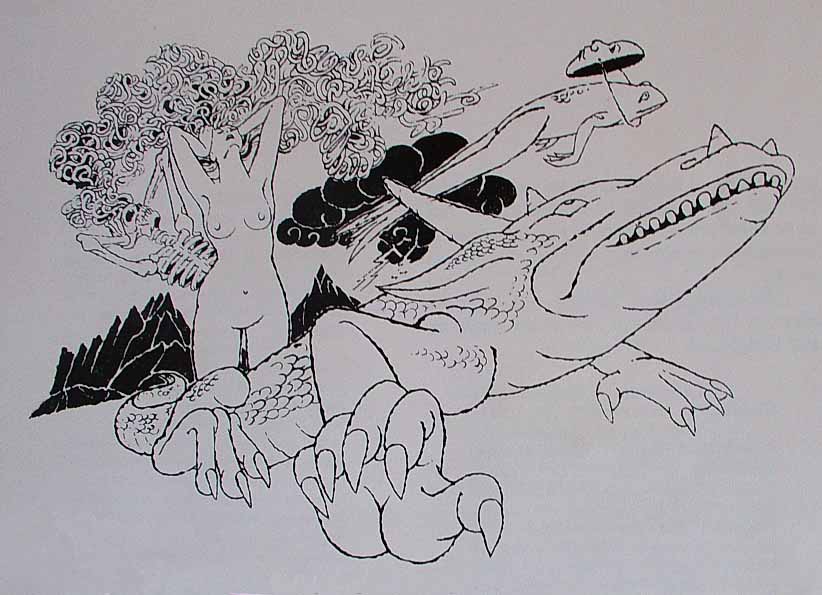
H. Doug Matsuoka
AND FINALLY—PARADISE
an excerpt
It could have been his absent-minded grasp that let the test tube slip from his hand onto the scuffed mahogany planking of the floor. Small fragments of glass crackled under his boots as he walked toward the eastern end of the lab to open a window. He wanted to let some air in and get a look at the surrounding fields of marijuana that had finally become familiar to him.
As a test, before opening the window, he closed his eyes and tried to visualize the scene that he hoped would confront him. The ridges of the Koolau mountain range, the valley, the fields on the slope, and to his extreme right, in the distance, the Pacific Ocean. He filled in his mental outline with color. The glossy green of the plants, brown almost black dirt between the rows, the severe violet of the Hawaiian sky and Hawaiian ocean (both fringed with white), and the piercing brightness of the unseen sun.
For the past twelve years he had given painstaking attention to the surrounding scenery. He observed and memorized the contour of the slope, every little tooth in the ridge, every modulation of color, every crooked line of shadow until the image embedded itself ineradicably in his memory creating a mental holograph of geography that he could exist in with a limited yet definite certainty.
He opened his eyes—it was all there. A wave of relief broke over him and he took a deep breath.
“Nick? . . . Dr. Nicholson?’ A voice calling him from the doorway of the lab. “Dr. Nicholson. It’s me, Nelson. Nelson Yamamoto. Remember me? Listen, can I talk with you for a second?”
What choice was there? But he said nothing. He kept looking out the window, peering toward the ocean. It was inevitable that his next station would be on the ocean. The agricultural project was over and they needed competent mentalities working the whale pens.
He commanded himself not to think about it. He looked up: the stars would be out tonight.
From Dr. Yamamoto’s Report—7 December XXXVII:
The Hawaii Agricultural Association’s Special Botanical Project, under the direction of Dr. Francis “Nick” Nicholson, has been a complete success. However, our data shows that Nicholson has not responded in a manner consistent with the predicted forecast (analog one one zero seven group Alpha). What is especially disturbing is the marked and continuous rate of down trending evident in the charts accompanying this report. The following transcription of the recorded conversation I had with him earlier today is illuminating in that it helps to show the basic manifestations of his problem.
Y. Nick, I know there’s a problem. A blind man could see it with a cane. The thing is, Nick, we don’t know just what it is. Look we’re friends aren’t we. What’s going on?
N: (Pause) We were friends. Once. Before they changed it.
Y: (He is referring to the period previous to March XXXV when I was a co-worker on the project)— The project, your project, was a success. You did it. There’s always more work to be done. Especially by a man of your caliber.
N: (No response)
Y: Governor Loo even sent you a public letter of praise. Doesn’t that mean anything to you? Listen. I’ve heard that the whale project needs a coordinator. You could take it if you wanted it. It would help make Hawaii independent of outside sources as far as food is concerned.
N: Yeah. Too bad about Fong and all.
Y: Fong was asking for it. He was a fool, an incompetent. One of the cortical implants was adjusted wrong and he failed to check, failed to follow procedure, failed to follow routine. The psyche fields had no effect whatsoever on that whale.
N: Hell of a way to go. Crushed and dismembered by a berserk whale. Whatever happened to the whale anyway? Did they catch him?
Y: They caught him alright. He’s probably on the market by now.
N: Eight seventy-five a pound at Star Supermarket.
Y: It’s around nine twenty now. Demand went up a click after the incident.
N: Whales used to be strong and graceful animals. The sleekest, most beautiful goddamned things in the ocean. Now they’re so fat and bloated they drown when the sea gets a little rough. Kept in invisible pens by little implants in their brains and transmitters in the water . . .
Y: Look Nick. There are still a lot of whales in the wild. We just breed a few so we can survive, so that they can survive too. We use every bit. Every organ, every square inch of skin, every fiber of gristle and cartilage, every ounce of flesh. We don’t waste anything. It’s not wanton slaughter. And I’ve noticed that you’re no vegetarian. I never seen you turn down a good steak.
N: The Hawaiians had a whale god. Did you know that?
Y: I wouldn’t doubt it.
N: Whatever happened to the Hawaiians? That’s a question, Doc. Whatever happened to them?
Y: What do you mean? They’re still around. Thompson, your senior assistant, he’s part-Hawaiian— You know that. Hawaiians and part-Hawaiians comprise a full five percent of our population. You must know- –
N: – -I mean, what happened to the old time Hawaiians? Their language and chants, their ways, orientations . . . their history. Their gods.
Y: Old time Hawaiians adapted to the modern world. Ancient Hawaiians can only exist in the ancient world. And I don’t think your problem has anything to do with Hawaiians at all. Maybe you feel guilty about being white. Or you’re just trying to throw me off. Right?
N: (No response)
Y: Nick. Take a break. Celebrate. Go out and have a good time. Just for one night. And then, tomorrow, you can come back and worry about whatever you want to worry about, think about whatever you want to think about. You can come back and think about God for the rest of your life if you want. Our Lady of Peace needs a new Monsignor. Nichiren needs a priest. You’re a big man now. You can have any post you want. But tonight, go to Waikiki and have some fun.
I’m not supposed to say anything, I’m not supposed to tell anyone about it, it’s classified, but I’ll tell you anyway. There’s a Holiday scheduled for tonight. And a big one too, for what I can tell. I’d go down there myself if I could get away from the monitors. Go down to Waikiki tonight Nick.
N: (Pause) No, I don’t think so, Doc.
Y: Yes, I think so, Nick.
N: That’s the prescription then?
Y: Yes, that’s the prescription.
N: I figured I was a candidate for restructuring.
Y: I don’t think you need anything that radical. I honestly don’t. A night in town, away from this broken down agricultural research facility or whatever the official name is, will do the trick, I think. The excitement of the holiday will do it.
N: What kind of Holiday?
Y: That part must remain a secret or it’s no fun.
N: Makahiki?
Y: What?
N: Nothing, nothing. I’ll go.
Y: Good. And Nick, come see me in the morning, okay?
N: Sure Doc. Anything you say.
Dr. Yamamoto in summary regarding Report—7 December XXXVII:
Y: I think that there is a chance that the holiday will do him good. It is my hope that the excitement will spark a kind of third level catharsis that will result in the realignment of the affected components in a spontaneous restructuring of the total psychic spectrum. I want to give that a chance before recommending a passive restructuring, which would be very risky in Nicholson’s case.
Just the same, I think that the chance of him spontaneously restructuring is very small, and I have already reserved time/space at the State Hospital at Kaneohe for him starting the day after tomorrow, 9 December XXXVII
Shinichi Ola Takahashi is from the Miyagi prefecture of Japan. He studied at Aoyama Art School and the Kuwazawa Design School in Tokyo. In 1971 he had a one-man show at the Ginza. During this period he became captivated by “Nihon-ga” (Japanese-style paintings) and soon fell into a period of creating religious paintings, particularly focused on “Jigoku-e” (hell scenes). Takahashi immigrated to Hawai’i in 1974 to become a pupil of Jean Charlot (1898-1979), a well-known Hawai’i mural artist. His view of art vastly developed in Hawai’i as he became engrossed in Western art movements like Cubism, Surrealism and DADAism. More on Takahashi’s work can be found at shintakahashi.com
H. Doug Matsuoka was born in Hilo, Hawai’i, and graduated from Kalani High School in 1970. Matsuoka is a writer and musician, among many other creative impressions. His serious interest in music came late—in his mid/late teens but he did initially study music theory and composition at the University of Hawaiʻi at Mānoa, before dropping out thinking he was smarter and more talented than he really was. Over the years he has been a musician in bands, notably The Hawai’i Amplified Poetry Ensemble, a writer, a gas station pump jockey, a computer guy, a basket case…all sorts of things which is what happens if you live a long time. This early version of “And Finally—Paradise,” was written in the late 1970s, and comes from some earlier acid trips through Waikiki, where Matsuoka tried escaping UFOs that were pursuing him by diving under parked cars.
Wayne Westlake
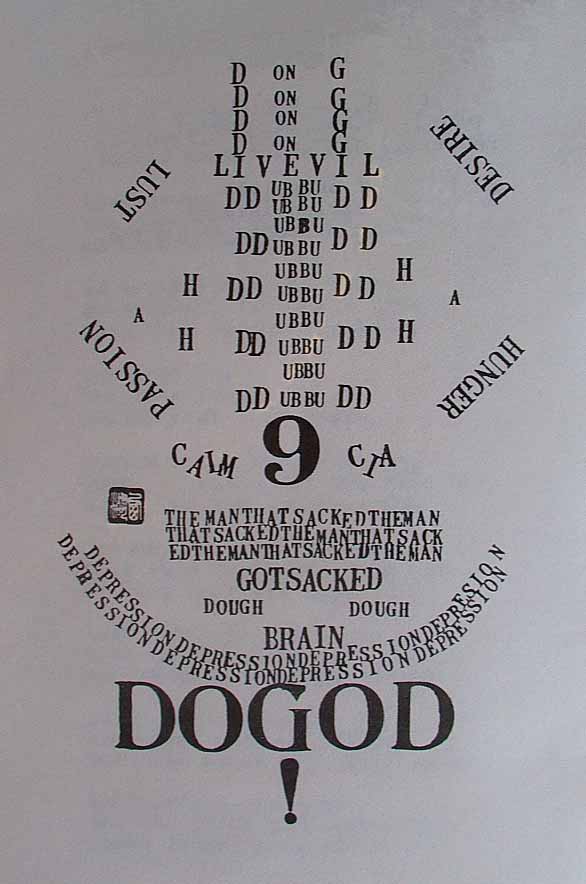
Wayne Kaumualii Westlake (1947-1984), is an internationally published Native Hawaiian poet whose work continues to be exhibited and published worldwide.
Westlake, Poems by Wayne Kaumualii Westlake, co-edited by Mei-Li Siy and Richard Hamasaki, was published by the University of Hawai’i Press. Westlake was an avid supporter of Native Hawaiian causes and issues, and his creative energy on such matters, was often channeled into his poetry, concrete poetry, essays, research,
and editing.
Richard Hamasaki
ARTIFICIAL CURIOSITIES
Low grumble of earth
trembling mountains
and everything quakes
a prolonged shiver that rattles the world
From below the foundations
of a plantation-style cottage, there is a low humming sound
that won’t disappear, a murmuring almost imperceptible
then the shaking subsides but does not stop
At this moment, there are no
trans-Pacific flights
off Diamond Head
approaching the reef runway,
but I can hear my neighbor,
an elementary school principal,
shrieking
at his 8-year old son
From where does this low hum originate?
not from the steady stream of cars
cruising the streets
Museums displaying
fine specimens,
striking colors sealed in
controlled environments:
Reading
Artificial Curiosities
“An Exposition of Native Manufacturers
Collected on the Three Pacific Voyages
Of Captain James Cook, R.N.”
thumbing my way
toward a section called
“Owhyhee or the Sandwich Isles.
Living images,
housed in museums and collections
throughout the world
documented, catalogued
and “safe”
protected so long as they remain
“artifacts” which can maintain traceable, pedigreed ancestries:
Artificial Curiosities
Vienna: “Feathered temple”
Leningrad: “Makaloa mat”
Greenwich: “Hawaiian spear”
Anonymous Private Collection: “Bowl with human images”
Berlin: “Feathered image”
Cambridge: “Two bracelets of turtle shell, dog teeth and ivory”
London: “Gourd rattle”
Edinburgh: “Shark tooth implement”
Glasgow: “Drum”
Dublin: “Idol’s eyes”
John Hewett Collection: “Barkcloth piece from bound volume”
Cape Town: “Feathered Helmet”
Sydney: “Netting sample for feather cape”
Honolulu: “Dagger”
Artificial Curiosities
Plant-dyed kapa, scented with extracts of flowers,
fragrant woods or leaves from Laka’s vine;
Polished wood-smooth tools and sharks’ teeth;
musical instruments worn like personal adornments;
Weapons and apparel of power;
religion of gods and feather dwellings
“Artificial Curiosities”?
Low rumbling thunder, distant,
within the earth
Scraping of stone blade upon rock.
Incandescence of amber rape lights
Interior illumination, the red-eyed video camera
From beneath the decaying cities,
museum walls shatter,
splintering display cases,
hum of magic, words melting words, images
transfusing red mulberry dye,
disintegrating, transforming
Foundations crumble, brittle;
car-splitting thunder
Towering mountain faces,
a blackened night sky issuing flashes of light.
Tendons straining,
mother-of-pearl eyes and mouths agape,
jagged tongues of lightning,
and the “bowl with human images” appears
above the vast portals, twin tunnels, grey concrete vaults collapsing
beneath the white-toothed mouths, blood red and gaping.
Two valleys of concrete and steel collapse,
and rising from mountain peaks
mammoth sculptures;
emerging human images of rock, skin like dyed kapa, dark as earth,
crouching, luminescent eyes, wide, like pohaku kekea,
arms and feet rooted in stone and earth yet bursting upward
swallowing strips of towering highway,
like a ribbon of clouds above the valley floors
the crushing weight of countless waterfalls
roaring from multi-fingered fisted cliffs
Museum pieces
as tall as mountains
as alive as
hurricane wind
and endless downpour
of rain
Artificial Curiosities, indeed
…artificial curiosities…
Are you
an artificial curiosity?
Richard Hamasaki is the author of Spider Bone Diaries, Poems and Songs, which was published by the University of Hawai’i Press. His poem “Artificial Curiosities,” is a selection from that book. He co-founded ‘Elepaio Press with his brother Mark Hamasaki, a photographer, book designer and printer. The first publication that the then new press put out, was Seaweeds and Constructions (1976-1984), which was, and is, an art and literary magazine of Hawai’i. The creative idea and energy, of the Hamasaki brothers, joined with featured co-editors Paul L. Oliveira and Wayne Kaumualii Westlake, along with artists Shinichi Takahashi, Kimie Takahashi, and many other contributors, which included such creative writers as Joe Balaz and H. Doug Matsuoka, to establish the magazine as an innovative and groundbreaking artistic expression of its time.
Laura Ruby
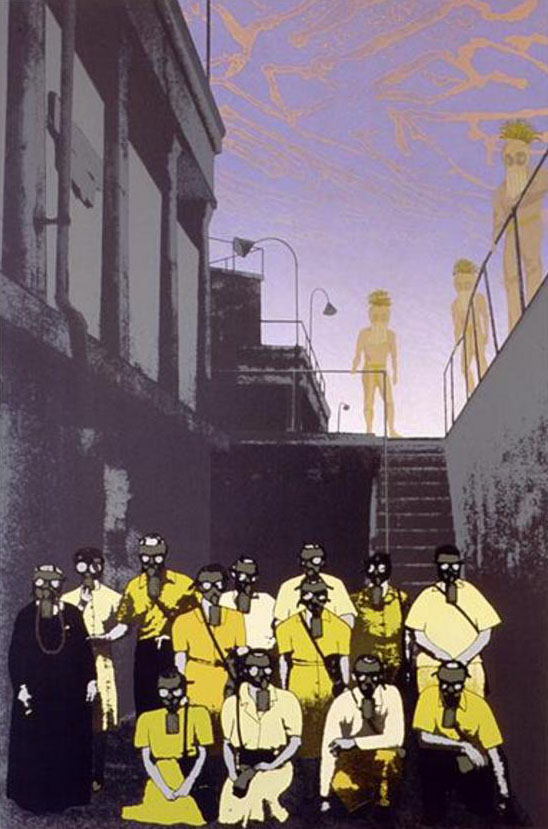
Orchid Tierney
prayer | suit
In Carbon County, the petronauts caw
to clear trees for the PennEast pipeline,
they say they have concerns about
contaminated air and groundwater,
mud swamps and wild trout streams,
unspoiled brooks to dip their feet in,
they say they can safely transport gas,
as a mausoleum of faculty,
and bring 12,000 jobs to the county,
they say they will post no trespassing signs
and conduct town hall meetings, distribute angry flyers
build websites and call radio stations
to raise public awareness,
they say natural gas is green like clean coal
and their teams live there,
they say they are citizens too
like bald eagles and bobolinks, bobcats and harrier hawks,
herons and cormorants, whose wetlands and parks are now at risk,
they say they will seize private and preserved lands using eminent domain,
they say Molly Maguire will fill their chests with smoke and culm,
stir up wasp nests in hillocks of black snow, because
everybody’s goal is mine more coal,
they say this is proof of my words. That mark will never be wiped out
this is your hous, notice you have carried this
as far as you can by cheating from a stranger he knows you,
so they prayed: o dear lord, please help us stop the pipeline, amen,
“Say, now you’re cooking with gas”
Orchid Tierney is a poet and scholar from Aotearoa-New Zealand, now residing in Gambier, Ohio. Her chapbooks include Brachiation, The World in Small Parts, Gallipoli Diaries, and the full length sound translation of Margery Kemp, earsay. First collection, a year of misreading the wildcats, is out from The Operating System. She received an MCW from the University of Auckland, an MA from University of Otago, and a PhD in English from the University of Pennsylvania. She is Assistant Professor of English at Kenyon College in Ohio.
Laura Ruby is a Hawai’i Living Treasure Honoree and a recipient of the Hawai’i Individual Artist Fellowship Award, and has exhibited her work widely. Her prints and sculptures have been shown in national and international juried and invitational exhibitions. She recently was a professor in the Art History department at University of Hawaiʻi at Mānoa, where she taught art and honors in a long career that has spanned a little more than three decades.
Lee A. Tonouchi
SIGNIFICANT MOMENTS IN DA LIFE OF ORIENTAL FADDAH
AND SON: COLLEGE
Aftah I wen graduate high school
my Oriental Faddah
wanted me
for go
Harvard, Princeton, Stanford,
AND Yale.
He nevah know
wea any of those places wuz,
jus dat das wea I had fo’ go.
So I went
UC Irvine.
Das wea I wen discover
dat my Oriental Faddah
wuzn’t really
my Oriental Faddah.
He wuz my
“Asian American” Faddah.
Dey sed I can have one Oriental rug
or some Oriental furnitures,
but I cannot
CAN
NOT
have
one Oriental Faddah.
Oriental is one term you use
for da kine inanimate objecks.
Das wot dey toll me.
So, I toll ‘em
“Oh, my Oriental Faddah,
he hardly sez anyting.
Das kinda like being
one inanimate objeck, ah,
Wotchoo tink?”
Ho, when I sed dat
their faces wen jus
freeeeeze,
like dey couldn’t believe
I sed someting
as disrespeckful as dat.
Tsk, “Asian American” das why.
SIGNIFCANT MOMENTS IN DA LIFE OF ORIENTAL FADDAH
AND SON: MARRIAGE
I came back home
wit one girlfriend
fiancée actually
who wuz one katonk.
Only she nevah know she wuz
one katonk.
She probably mo’ used to
da term
banana.
Either way, my Oriental Faddah
wuz happy
katonk, banana,
TWINKIE,
so long as Oriental he sed.
“Asian American,” she correck-ed.
Jus for fun
I took her to one
Frank Delima show
at da Polynesian Palace.
But she nevah laugh,
not even one chuckle
for wot she called
“the blatant
stereotyping and racist
ethnic portrayals.”
So I started playing around, brah.
Aftah da show,
I started telling all my friends
“Eh, wassup Oriental!”
“Ooo, you friggin’ Oriental!”
“Brah, yo’ Mama, she so Oriental
I bet she cannot see her chopsticks
unless she turn ‘em sideways!”
I figgah I would take back
da term!
If Popolo people can
use da “N” word, den hakum
I cannot use da one
dat starts wit “O?”
ENPOWERING li’dat.
She tot I wuz nuts.
Out of my freakin’ mind!
So she got back on her plane
and left.
Looking in da air
all I could tink wuz
Wot Lucille,
You going leave me now?!
Even though Lucille
wuzn’t even
her name.
Lee A. Tonouchi stay one Okinawan yonsei from Hawai’i known for writing in
Hawai’i Creole English. His poetry collection Significant Moments in da Life of Oriental Faddah and Son: One Hawai’i Okinawan Journal won da 2013 Association For Asian American Studies Book Award. Most recently he stay da recipient of da 2021-2022 Tony Quagliano Poetry Award and da 2023 American Association for Applied Linguistics Distinguished Public Service Award for his work in raising public awareness of important language-related issues and promoting linguistic social justice.
John M. Bennett
Maya Heads
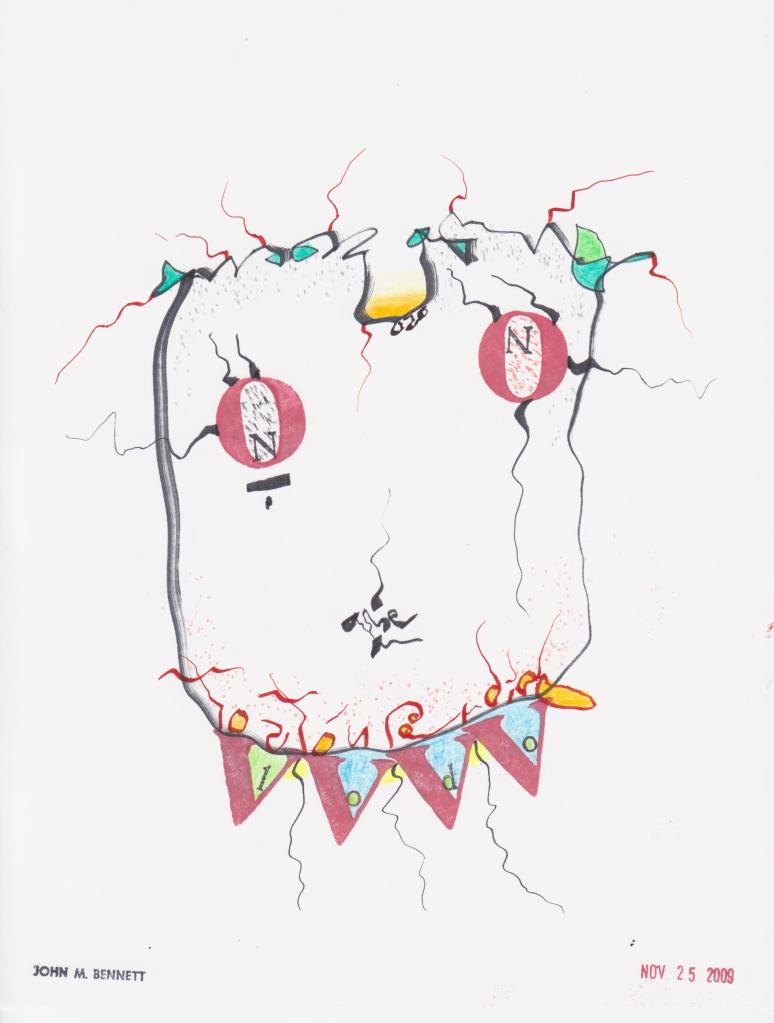

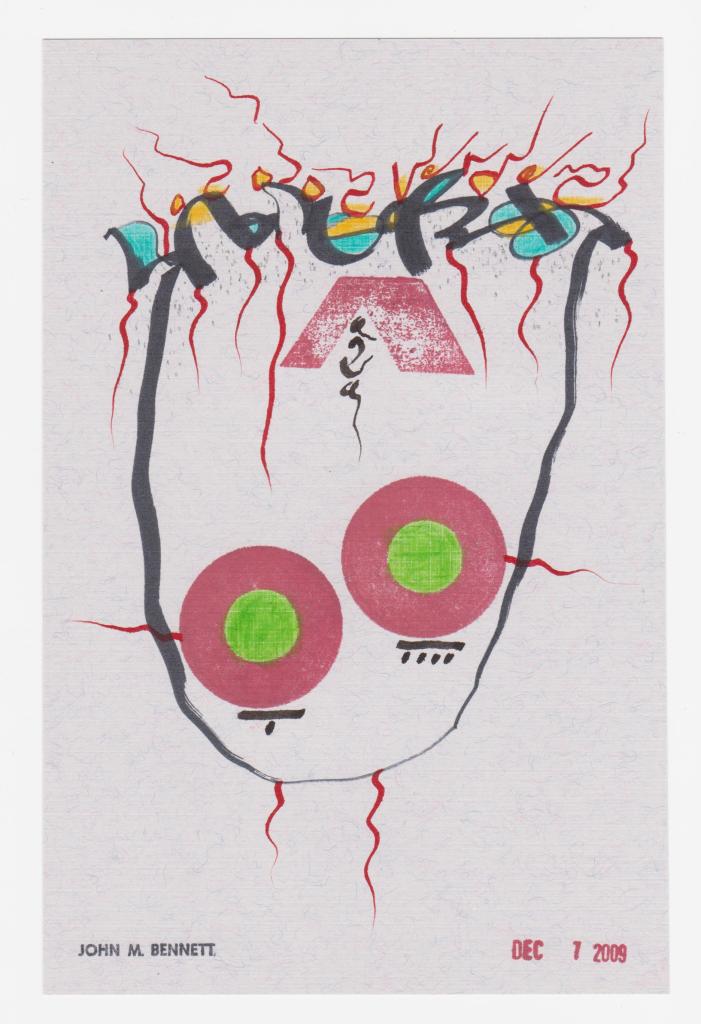
John M. Bennett has been widely published, and has exhibited and performed his word art worldwide in numerous publications and venues. He was the editor and publisher of Lost and Found Times, from the middle 1970s to the early 2000s, and he is the Curator of the Avant Writing Collection at The Ohio State University Libraries. He has a PhD in Latin American Literature and lives in Columbus, Ohio.
Jason Floyd Williams
last stop.
We’re three months early for the Last Stop Willoughby Festival,
so we wait at a local diner.
Barry is two stools away from us.
He introduces himself.
He’s a restaurant regular.
A neighborhood fixture.
You can tell.
Third sentence into his biography is he’s dying.
Bone cancer.
Three years to live.
Age 60.
Barry incubated with fluorescent lights.
Barry raised with ink toners & filing cabinets.
Barry with his translucent thin skin throbbing
to “I think we’re alone now” on the jukebox.
Barry whose Sears Roebuck dress shirt, & matching pants,
reveals a life in accounting; a life indoors; always indoors.
A plastic houseplant.
Barry combs back his receding shrubbery hair & leans in closer,
Covid-catching-closer, and says he’s afraid to die alone.
That’s why he’s pursuing younger women, 20-30 yrs old.
Like that cute blond over there, he points curled finger.
She’s with a Beefcake boyfriend.
They glance over our way.
I tell the waitress to make our food to go.
Mary Ellen Derwis
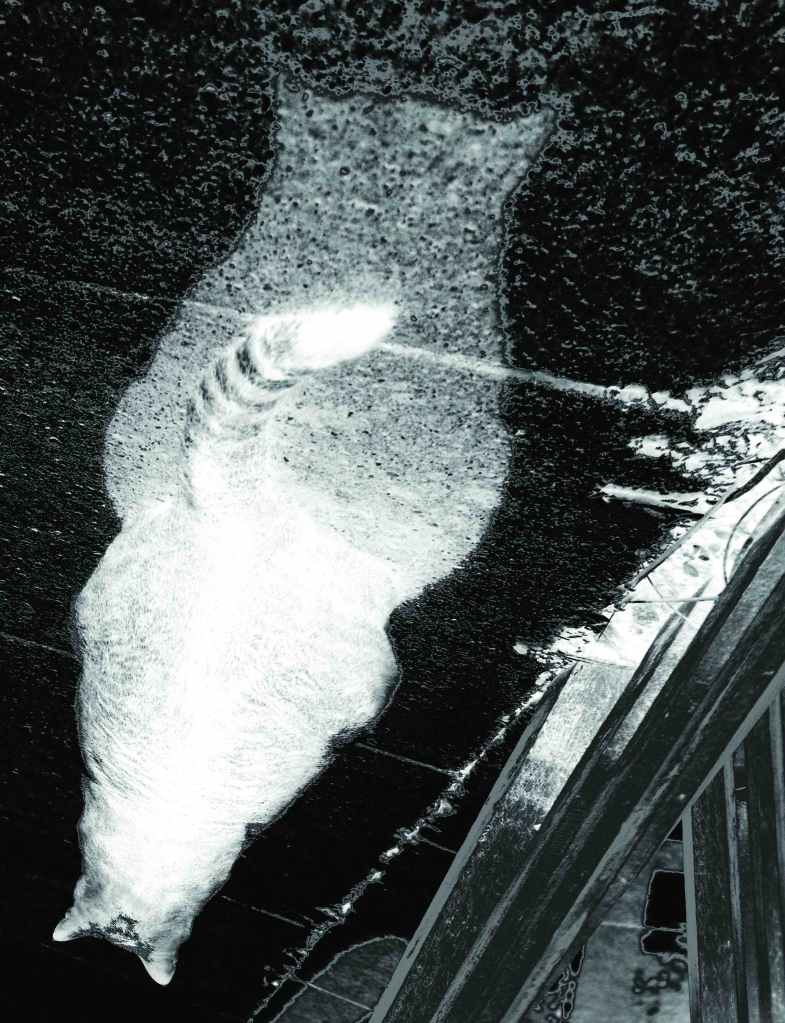
unseen luggage.
Shane was waiting outside my shop, 15 minutes before we opened.
It was 35 degrees out.
He’s wearing a dark, sleeveless flannel,
gray scarf around neck, & his bare arms are littered with Egon Schiele-jigsaw-tattoos-designed-70s-
rock-album-covers.
We’re both wearing our cheap blue disposable masks
cause it’s the days of Covid.
I invite him into the shop.
I ask him how things are with his back.
He was getting nerve block & maybe some vertebrae fused last time we talked.
He’s doing more regular shots nowadays, no surgery scheduled. Too tricky.
What messed up your back? I ask.
Work, genetics?
This was a Kerouac cosplayer valve release of an almost hypnotic regression:
“It may have been when my mother, an awful woman, threw me through a glass table.
I was four years old.
Or when she kicked me down the stairs.
I was a little older.
I remember that one vividly.
My mother & step-dad were terrible.
My step-dad tortured & killed my younger brother, Jack.
Chained Jack to the gas radiator; burned his skin.
Eventually the ol man choked poor Jack out.
Or, there was the time I flipped an18-Wheeler in Pittsburgh.
Took the exit too hard; spilled oil-contaminated soil all over the freeway.
Or, that time, a few years back, when that woman–texting–hit me
straight going 45mph…”
“Waitaminnut,” I interrupt.
“Your step-dad killed your brother?
I hope he went to jail.”
“Yeh,” Shane continued. “He did.
And the other prisoners didn’t like child killers.
They learned my step-dad had a metal plate in his head,
from a construction injury.
They waited for him in a jail corridor.
They waited for the guards’ shift change.
They waited for him to be alone.
They attacked him.
Kicked in his metal plate & killed him quickly.
I wasn’t upset when I heard that.
He was a terrible man.”
Jason Floyd Williams, like Bill Bixby from The Incredible Hulk TV series, often finds himself followed by sad piano music & hitchhiking, usually in the rain, from one Ohio town to the next. If you see him at a small town diner or bar, call the local sheriff. Some of his warrants may be attached to rewards.
Mary Ellen Derwis is a painter and photo artist, and her work has appeared in various publications online and in print. She was born and raised in Cleveland, and later lived in San Francisco, California, and in Hawai’i. She returned to live in Northeast Ohio for a little more than a decade, before recently moving to live in Virginia.
Luigi C. Russo
I KNEW IT
Once I kissed her pink lips
and touched her dark skin
I knew there would be trouble for me
I knew the green would turn brown on the trees
I knew it all along
I knew it all along
Just to walk with her, holding hands
would cause a stir among the lands
I knew there would be some strangeness for us
I knew the yellow paint could chip off the school bus
I knew it all along
I knew it all along
Since we been together everyday
nothing to separate us, nothing to betray
I knew there would be fires from those I know
I knew the sun would refuse to show
I knew it all along
I knew it all along.
Now the dark woman is a distance to travel
and my heart is hers, is hers, all
I knew there would be a troubled paradise
I knew thirteen would roll from the dice
I knew it all along
I knew it all along
Luigi C. Russo is a family man and library worker. He is the author
of several books of poetry. The poem “I Knew It” is from
Chorus Chorus Come To Me, one of his books of poetry. He lives
in Portage County, Ohio.
Peter Chamberlain
The Pictorial History of the Evolution of the Jazz Clarinet
as ReWritten by Mint Romkey
(A Tribute to Mezz Mezzrow)
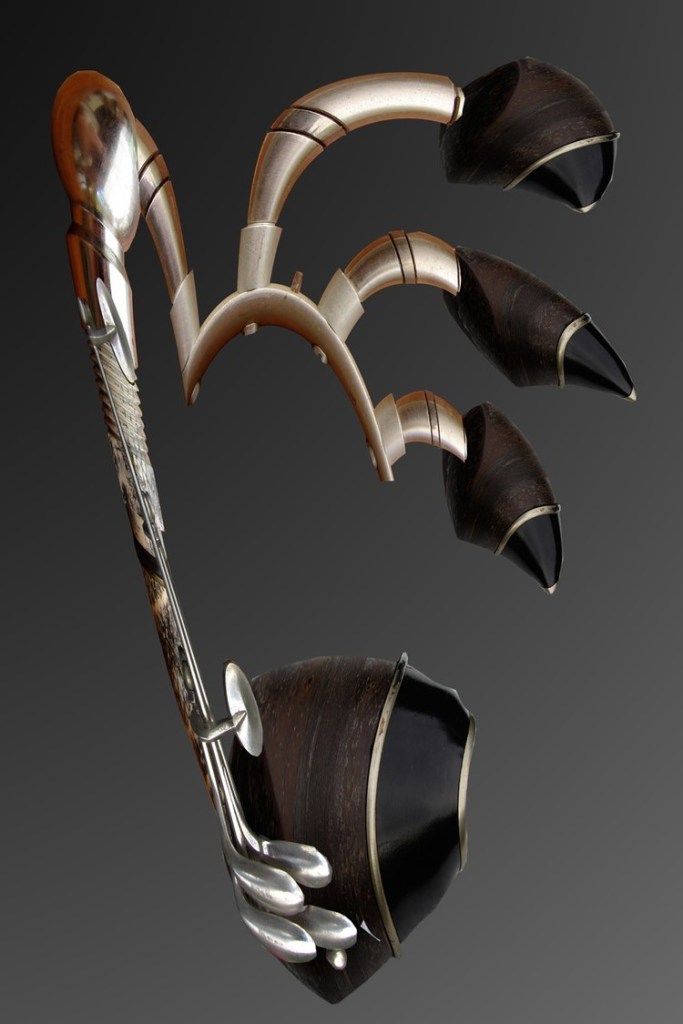
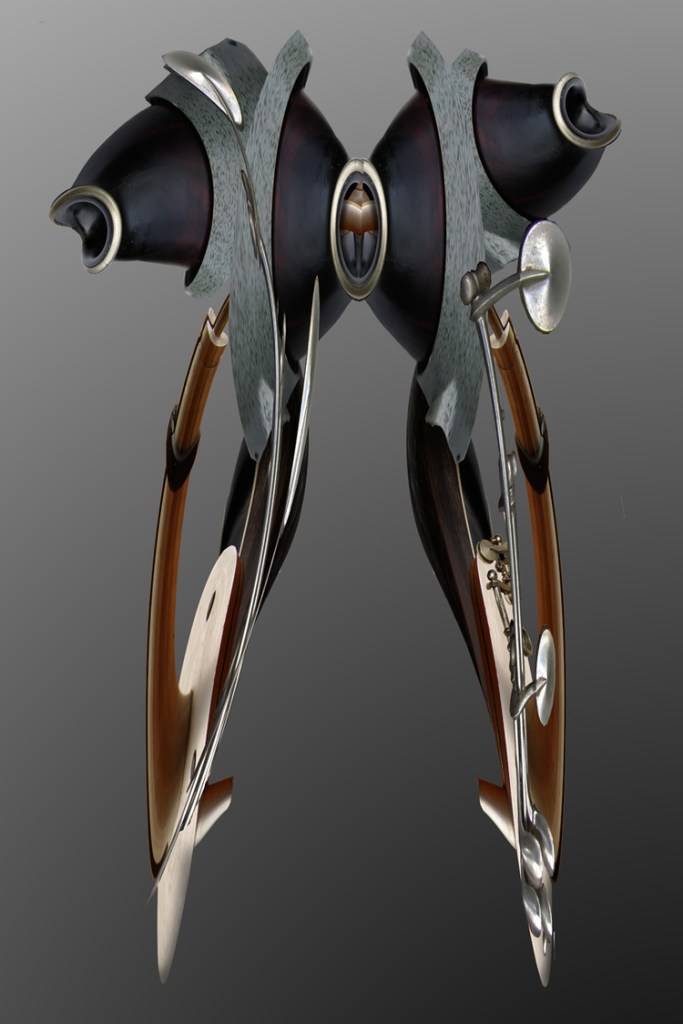
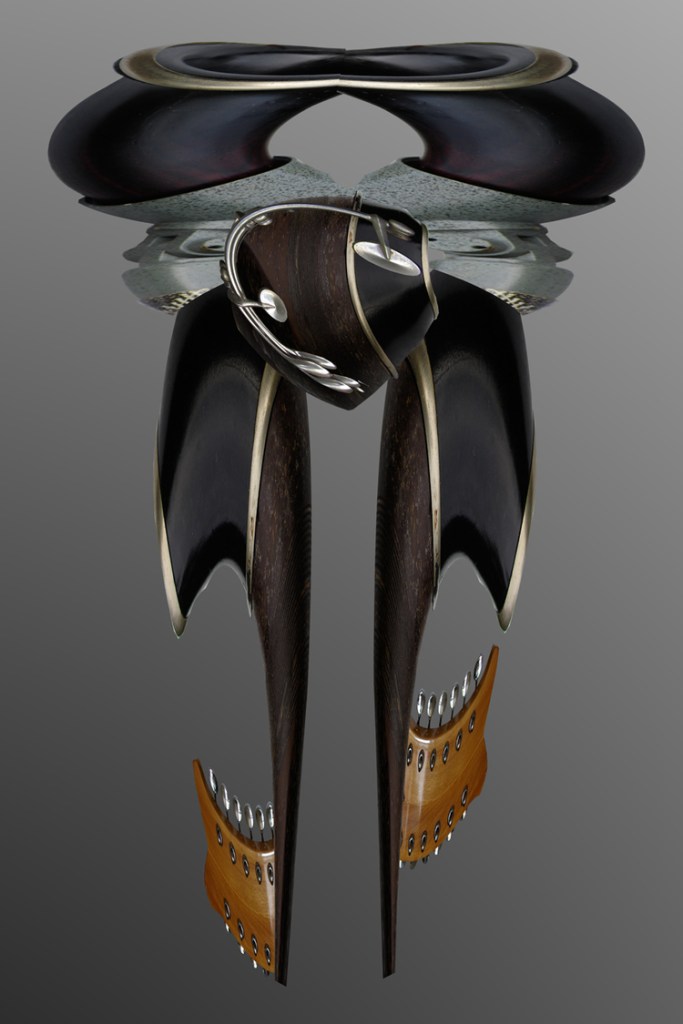
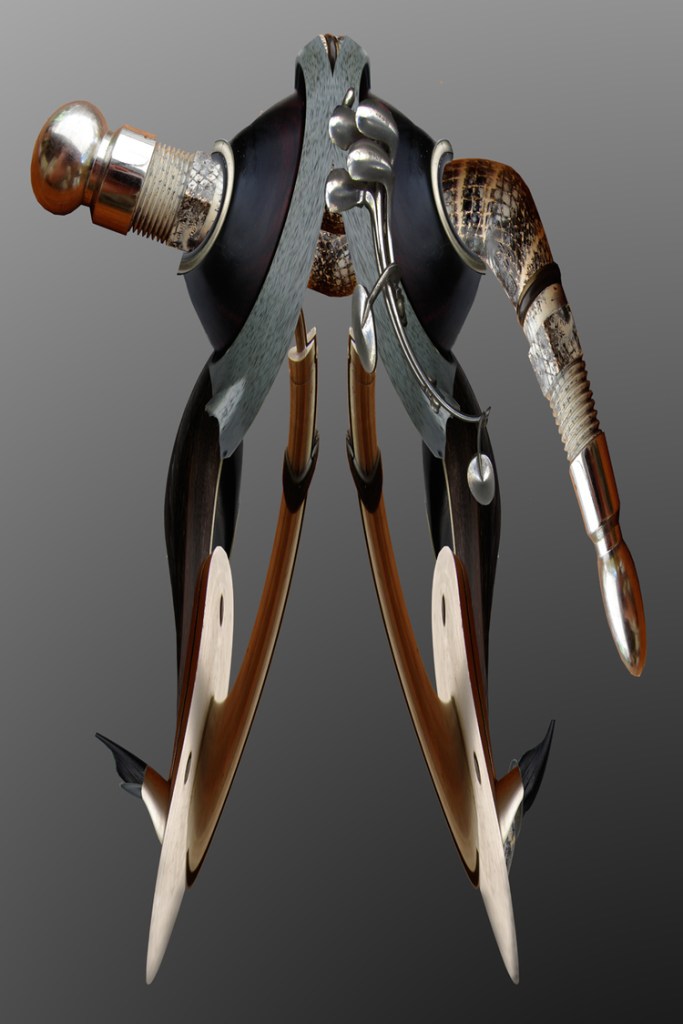

Peter Chamberlain is an artist, musician, and educator. Throughout four decades of teaching and working in the areas of expanded arts and intermedia he has emphasized systemic structure: the structure of process, of production, of value systems, of composition, of the art world, etc. Content has mostly addressed unlikely juxtapositions between nature, culture, and technology. He has taught Expanded and Electronic Arts at the University of Hawai’i since 1991, and prior to that taught Sculpture and Video at Elmira College in New York State since 1976. He retired in August of 2022, and presently lives in Palolo, Hawai’i.
Chamberlain has widely exhibited and performed his work in Hawai’i, throughout the US, and internationally. A large extent of his expansive work can be found at:
peter-chamberlaingph8.squarespace.com
13 MILES FROM CLEVELAND
Edited by Joe Balaz
Joe Balaz lives in Northeast Ohio in the city of Cleveland. He edited Ramrod–A Literary and Art Journal of Hawai’i, and was also the editor of Ho’omanoa: An Anthology of Contemporary Hawaiian Literature.
All works appearing in 13 Miles from Cleveland are the sole property of their respective authors and artists and may not be reproduced in any way or form without their permission. © 2022.
 13 Miles from Cleveland